Three familiar Denver places, one shared story of service, and a few ways to honor it this Veterans Day.
By Nookhaven Staff | November 11, 2026
On a Saturday afternoon in east Denver, families drink at long tables at the Lowry Beer Garden, a few steps from an aircraft hangar big enough to hold a B-52. In Aurora, doctors and students cross a busy medical campus anchored by a tall, cream-colored hospital building that has stood there since 1941. In southwest Denver, white headstones run in even rows along Sheridan Boulevard.
Most of us pass these places without thinking much about them. But each one was built by service, and each one still carries the story of the people who served there and the families who served alongside them.
Veterans are part of our community. In Colorado, they make up about 7% of the adult population, above the national average of 5.9%. They are our neighbors, our clients, our friends, and our family. This Veterans Day, we wanted to honor them and their families by looking at three Denver places their service shaped. A familiar name runs through all three: a young Army officer named Dwight Eisenhower, who married a Denver girl named Mamie Doud and kept coming back.
Fort Logan: where it began
Fort Logan is the oldest of the three. The Army established it on October 31, 1887, on open land southwest of the city, and later named it for John A. Logan, a Union general in the Civil War. For nearly 60 years, soldiers trained, drilled, and lived there with their families, until the Army left in 1946.
In 1924 and 1925, Captain Eisenhower was stationed at Fort Logan on recruiting duty, and he and Mamie lived in a duplex on officers’ row. The Field Officer’s Quarters next door, built in 1889, is now a small museum run by the Friends of Historic Fort Logan, who have spent years restoring it to the way it looked in the 1890s.
The fort’s most lasting legacy is its cemetery. It began as a post cemetery in 1887. The first burial was Mabel Peterkin, the young daughter of a private stationed at the fort, a reminder that military families have always served too. In 1950, it became Fort Logan National Cemetery, which today holds more than 100,000 graves. The grounds are open to visitors, and walking them on Veterans Day is a quiet, powerful way to mark the day.
Lowry: from air base to neighborhood
Lowry Field opened in 1938 and was named for Lieutenant Francis Brown Lowry, a Denver native and Colorado’s only aerial observer killed in World War I. Over the next 56 years, it became one of the Air Force’s most important training bases. By the time it closed in 1994, Lowry had trained more than 1.1 million service members.
Some of its history is surprising. On July 11, 1955, the first class of the US Air Force Academy, 306 cadets, was sworn in at Lowry, and the Academy stayed there until 1958, while its permanent campus in Colorado Springs was being built. During the same years, Lowry served as President Eisenhower’s Summer White House. Mamie’s family still lived in Denver, so the Eisenhowers visited often and attended services at the base chapel, now called the Eisenhower Chapel.
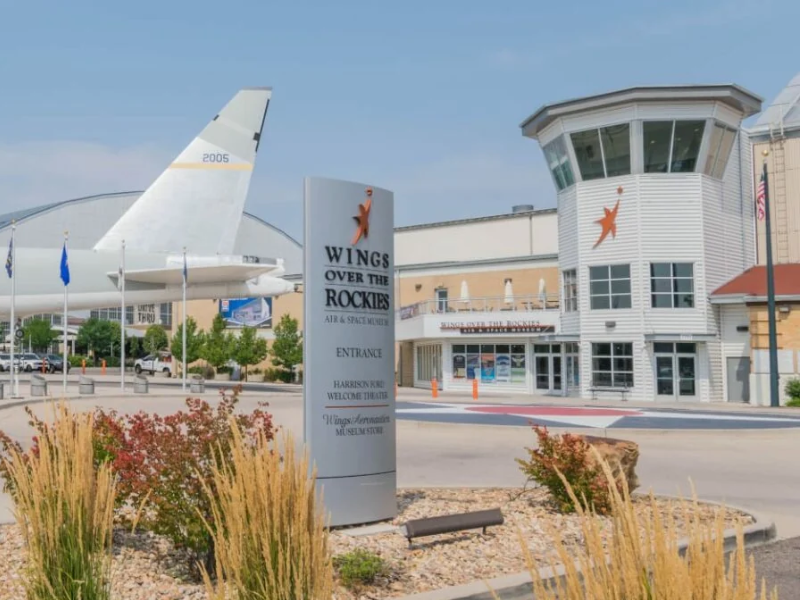
When the base closed, Denver had a choice to make, and it chose to keep the history. The redevelopment kept about 30 original buildings. Hangar No. 1 became the Wings Over the Rockies Air & Space Museum, with a B-52 bomber parked out front. Another hangar now holds an ice rink. Today Lowry is one of Denver’s best-loved neighborhoods, and its history is still easy to see if you look for it.
Fitzsimons: a place of healing
Fitzsimons began in the final months of World War I as Army General Hospital No. 21, built to care for soldiers returning with tuberculosis and other illnesses. In 1920, it was renamed for Lieutenant William Thomas Fitzsimons, an Army doctor and the first US Army officer killed in that war.
The hospital’s main building opened on December 3, 1941, four days before Pearl Harbor. During World War II, it treated around 5,000 patients a day. Later, it cared for wounded soldiers from Korea and Vietnam, many of them recovering from chest wounds.
In September 1955, Fitzsimons received its most famous patient. While on vacation in Denver, President Eisenhower had a heart attack and spent seven weeks recovering on the hospital’s eighth floor. He celebrated his 65th birthday there, and a few weeks later took his first steps without help on the hospital roof, in front of reporters. A suite on that floor still commemorates his stay.
Fitzsimons closed in 1996. Today the site is the Anschutz Medical Campus, home to the University of Colorado Hospital and Children’s Hospital Colorado. Its care for veterans continues there too. In 2018, the Rocky Mountain Regional VA Medical Center opened on the former Fitzsimons grounds, more than 20 years after veterans first proposed building it there.
Service is still part of Denver
These stories aren’t only about the past. Buckley Space Force Base in Aurora is still active, and thousands of service members, veterans, and military families live in neighborhoods across the metro area. Some have lived here all their lives. Others arrived on orders and decided to stay. Many of us know them as the neighbor who helps shovel the walk or the friend who never mentions their service unless someone asks.
Ways to show up this week
- Join the Denver Veterans Day Run, Parade, and Festival. The 17th annual event, hosted by the Colorado Veterans Project, takes place Saturday, November 14, at City Park. You can run or walk the 5K or 10K, or simply come cheer on the parade. Details at denverveteransday.com.
- Visit one of these places. Spend an hour at Wings Over the Rockies, walk through Lowry with its history in mind, or pay your respects at Fort Logan National Cemetery.
- Ask, and listen. If there’s a veteran in your life, ask about their service and where it took them. Many have stories they rarely get to tell. The same goes for military spouses and families, whose service is easy to overlook.
The next time you pass that hangar in Lowry, the old hospital in Aurora, or those white headstones on Sheridan Boulevard, we hope you’ll see them a little differently. They are some of Denver’s most familiar places, and they hold the stories of people who served, the families who served with them, and a city that has been shaped by both.
We love sharing thoughtful perspectives on home, place, and everyday living. If this sparks a question or curiosity, we’d always be glad to connect and continue the conversation here.