The Easiest Way to Make Your Bedroom Feel More Restful
There’s a certain feeling we’re all hoping for in a bedroom.
Not perfectly styled. Not overly designed. Just calm. Quiet. Easy to settle into at the end of the day.
The kind of space where your shoulders drop a little when you walk in. Where the day doesn’t follow you all the way to bed.
And when that feeling is missing, most people assume it’s something bigger: new furniture, better bedding, a full refresh.
But more often than not, it’s something much simpler, and even much easier to change.
It Usually Comes Down to Lighting
If a bedroom feels slightly off at night, maybe it’s too bright, too stark, or just not quite relaxing—lighting is often the reason.
During the day, most bedrooms feel perfectly fine. Natural light fills the space, everything feels open, and nothing seems out of place.
But at night, that same room can shift.
Overhead lighting, especially cooler or brighter bulbs, tends to keep the space feeling alert. It’s the kind of light that works well in kitchens and workspaces, but not necessarily in a room meant for rest.
And when that’s the only light source, the room never really transitions into a softer, more restful version of itself.
The Shift Doesn’t Have to Be Big
Creating a more calming environment isn’t about redesigning the entire room. It’s about giving yourself more control over how the space feels as the day winds down.
That usually starts with layering light instead of relying on just one source.
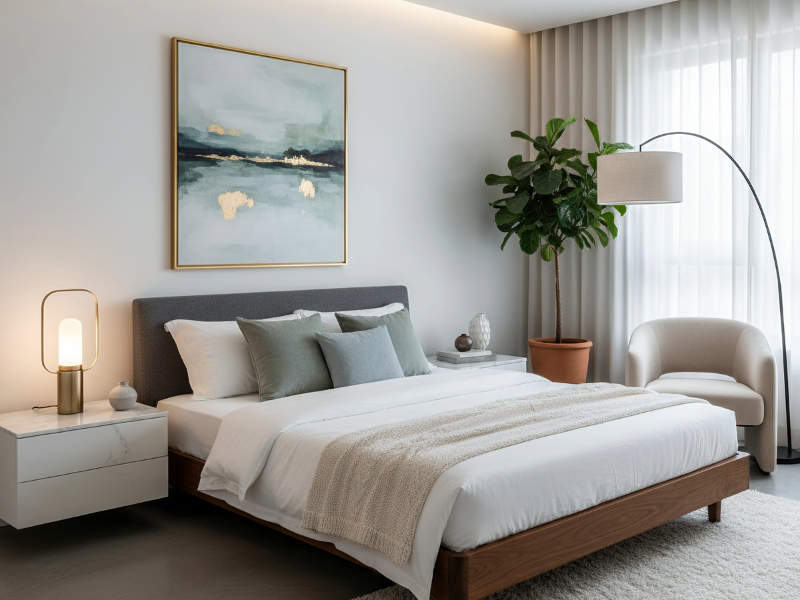
A bedside lamp you reach for in the evening instead of the overhead.
A warmer bulb that softens the tone of the room.
A dimmer switch that lets the light ease down gradually.
These are small changes, but they can change how the room behaves at night.
Instead of feeling bright and purely functional, it starts to feel quieter. More intentional. More in sync with how you actually want to end your day.
Let the Room Breathe a Bit
Once the lighting feels right, the next shift is often more about editing than adding anything.
Bedrooms tend to collect things over time. Extra decor, stacks of books, surfaces that slowly fill up. Individually, none of it feels like too much. But together, it creates a kind of low-level noise.
Not loud. Just enough to keep the space from feeling fully settled.
Pulling a few things back can make a noticeable difference. Clear a nightstand, simplify what’s in view, or give surfaces a little breathing room.
It allows the room to feel quieter, both visually and mentally.
Softness Matters More Than You Think
From there, it’s about how the space feels and looks, but mostly feels.
Layered textures can shift a room in a subtle but meaningful way. A heavier duvet. A softer throw. A rug that feels good underfoot.
These details don’t need to be styled or perfect. They just need to invite you in.
Because at the end of the day, a restful bedroom is about how easily you can settle into it.
The Goal Isn’t Perfection
It’s not about creating a showroom.
It’s about creating a space that supports you at the end of a long day. One where the lighting softens naturally, where nothing is competing for your attention, and where the room feels like it’s winding down with you.
That moment when you get into bed, the light is low, and everything feels just a little quieter is usually the signal.
You don’t need to do more.
You’ve already done enough.
Inspired by insights from Better Homes & Gardens.
We love sharing thoughtful perspectives on home, place, and everyday living. If this sparks a question or curiosity, we’d always be glad to connect and continue the conversation here.