A quick guide to picking the right pumpkin for carving, stacking, or simply setting out, and making it last in Colorado’s dry air.
By Nookhaven Staff | October 19, 2026
Most of us choose a pumpkin the same way every year. We walk up to the pile, at a patch or right outside the grocery store doors, and grab one that looks about right. Round enough. Orange enough. Not too heavy to carry to the car.
It usually works out fine, until you get home, pick up the carving knife, and find out the shell is as thick as a cutting board. Or the beautiful blue-gray one you bought for the front steps turns out to be nearly impossible to carve. Some pumpkins are made for carving, and some are made for sitting pretty. A little knowledge before you grab helps you bring home the right one.
Pumpkins made for carving
Technically you can carve any pumpkin, gourd, or squash. Some are just much more cooperative.
Cronus is the classic jack-o’-lantern pumpkin: deep orange, with a thick, curved stem and walls that cut cleanly. If you picture “Halloween pumpkin,” you’re probably picturing something like it.
Jack o’Lantern is the aptly named variety, around since the 1950s. It grows to about 10 inches tall and rounds out nicely, so it’s a good size and weight for kids doing their own carving.
Howden is a little smaller than Cronus and easy to find. Its sturdy stem helps it hold up longer once it’s carved.
Casper is bright white with smooth skin, great for carving and even better for painting. A white jack-o’-lantern lit from inside has a soft, ghostly glow an orange one can’t match.
Pumpkins made for stacking
If you like a pile of pumpkins on the steps or a tall stack by the door, you want shapes that sit flat and hold weight. These are hard to carve, so let them be the foundation.
Rouge Vif d’Etampes, often called the Cinderella pumpkin, is wide, flat, and deeply ribbed, in red-orange shades. It looks like it rolled out of a storybook and makes a sturdy base.
Jarrahdale has silvery blue-gray skin and deep lobes. It’s one of the most striking pumpkins you’ll find, and it pairs beautifully with oranges and whites.
Flat White Boer is the one to look for if you want a white base. Most white pumpkins are round, but this one is flat enough to stack on.
Pumpkins made for admiring
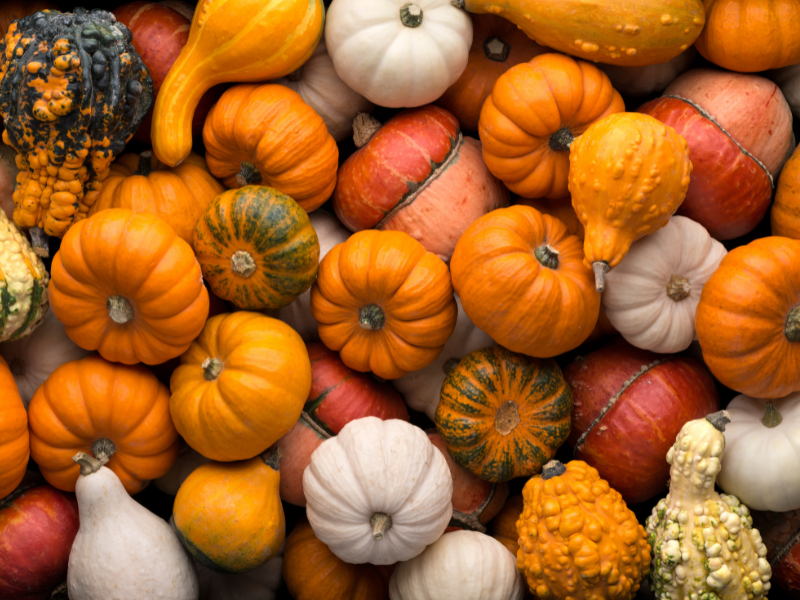
Not every pumpkin needs a face. Some of the most interesting ones are best left whole and arranged in groups, where their shapes and textures can do the work.
Turk’s Turban looks like a pumpkin wearing a hat, with a bulbous top in striped orange, green, and cream.
Winter Luxury is covered in a fine, silvery netting that gives it an almost frosted look.
Sunshine Kabocha is a bright, saturated orange with skin too thick to carve, which makes it ideal for display.
Tetsukabuto is dark green and squat. It’s best left whole, or lightly etched if you want a design without a full carve.
Thelma Sanders is small and creamy tan. It’s perfect for tucking around bigger pumpkins or setting along a mantel.
You won’t find all of these in a grocery store pile. Farm stands and farmers markets are your best bet for heirloom varieties, and it’s worth asking what they have before you settle on the usual orange. If you’re still looking for a patch to visit, our Peak Season guide has a few favorites around the Front Range.
Making them last in Colorado
Here’s where our climate changes the advice. In humid places, the enemy is mold. Along the Front Range, it’s dry air.
Uncarved pumpkins hold up well here. Low humidity is kind to a whole pumpkin, which is good news for anything you’re displaying rather than carving. Start by wiping off dirt with a damp cloth, and handle pumpkins by the bottom rather than the stem. A cracked or snapped stem is where rot usually starts.
Carved pumpkins dry out fast. Once the shell is open, Denver’s dry air pulls moisture out quickly, and a jack-o’-lantern can start to shrivel and cave in within days. Carve closer to Halloween rather than the weekend before. Rubbing petroleum jelly or vegetable oil on the cut edges helps slow the drying, and on especially dry days, a quick mist of water on the inside helps too.
Try a vinegar bath. A soak in one part vinegar to ten parts water for 20 to 30 minutes, before and after carving, helps keep surface mold and bacteria down. It matters less here than in wetter climates, but it doesn’t hurt.
Skip the bleach. Bleaching pumpkins used to be common advice, but it’s hard on wildlife and the environment, and squirrels and birds will find your pumpkins whether you invite them or not.
After Halloween
Choosing the right pumpkin pays off once Halloween is over. Jack-o’-lanterns are done by November 1, but the stackers and the ones made for admiring aren’t spooky to begin with. Clear off the carved ones, and a Cinderella pumpkin, a Jarrahdale, and a few Thelma Sanders look just as good on the steps in mid-November as they did in October. Most will easily carry you to Thanksgiving.
When they’re finally done, don’t send them to the landfill. Denver residents can drop pumpkins at the city’s LeafDrop sites, open weekdays through November 25 with weekend locations in November, or put them in a green compost cart. Remove any candles first, and leave out painted or glittered pumpkins.
So the next time you find yourself in front of that pile, take a second look. The pumpkin that looks about right might be the one that lasts all season.
Inspired by writing in Better Homes & Gardens. All writing is original, re-voiced, and locally grounded for the Nookhaven community.
We love sharing thoughtful perspectives on home, place, and everyday living. If this sparks a question or curiosity, we’d always be glad to connect and continue the conversation here.