It happens more often than it should. A seller renovates the kitchen, with real money and real intention, and lists the home proud of the upgrade. Then a buyer walks through, and instead of “wow,” the reaction is something closer to déjà vu. Not because the kitchen is old. Because it was designed like it already was.
It doesn’t take a whole gut renovation gone wrong. Usually it’s one or two choices, made with confidence at the time, that quietly locked the whole room into a specific year. Here’s where that tends to happen and how to avoid it.
The theme trap
Every era has its kitchen theme: the rooster motif, the Tuscan vineyard look, the all-copper moment. These read as “on trend” for exactly as long as the trend lasts, and not a day longer. The safer move is to build the bones of the kitchen (cabinetry, counters, and layout) around materials that don’t expire, and save any trend-chasing for the things that are easy and cheap to swap out later: a paint color, a set of hardware, a run of open shelving styled with a few pieces.
Countertops that give away the decade
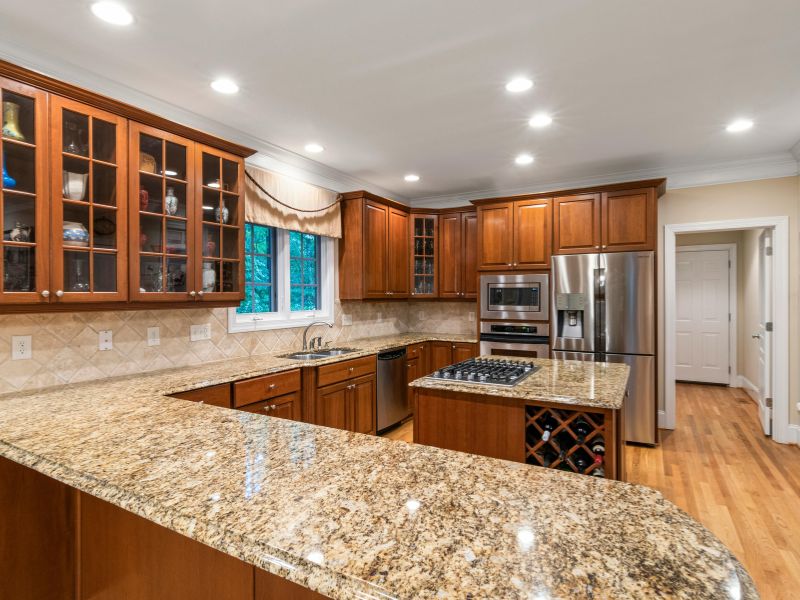
Laminate dated a kitchen in the ’80s and ’90s. Quartz is starting to do the same thing now for a different reason. It’s not a bad material. It’s just everywhere, and “everywhere” ages fast. Natural stone costs more up front, but it doesn’t carry a decade stamp the same way. If budget is tight, a quartz with movement that reads closer to natural stone holds up better over time than a flat, uniform slab.
Lighting that upstages the room
A dramatic pendant or an oversized fixture can feel like the whole design statement in the showroom. In the kitchen, it’s usually the first thing a buyer’s eye lands on. That means it’s also the first thing that reads as “a choice from a few years ago” once the trend moves on. A simpler fixture, with the drama saved for something easier to change later, such as a runner, a stool, an accent wall, tends to age better.
A backsplash with no relationship to the rest of the house
A bold backsplash isn’t the problem. A backsplash that has nothing to do with the rest of the home is. If the kitchen tile doesn’t share any DNA with the flooring, the cabinetry, or the finishes in the adjoining rooms, it reads as a decision made in isolation. That is exactly what makes a kitchen feel like a snapshot of one specific renovation, rather than part of a considered whole. Especially in Denver’s older bungalow stock, where a kitchen often opens straight into a dining or living space, cohesion across the sightline matters more than the backsplash on its own.
Appliances chosen for looks over longevity
Colored or heavily styled appliances can feel fresh in the moment, but they date fast and they’re expensive to replace once they do. Stainless or panel-ready finishes read a s neutral rather than trendy, which is exactly why they’ve stayed the default for so long. If personality is the goal, a single striking range is a better splurge than a matching colored suite.
The takeaway
None of this means playing it safe to the point of boring. It means being honest about which choices are structural, and which ones are decoration, meant to be swapped out long before they have the chance to date anything. Get that distinction right, and the “new kitchen” on the listing actually reads as new, whenever someone walks through the door. Whether that’s tomorrow or in a future decade.
Inspired by writing in Real Simple
We love sharing thoughtful perspectives on home, place, and everyday living. If this sparks a question or curiosity, we’d always be glad to connect and continue the conversation here.