Why one number carries so much weight, and the practical ways buyers and sellers are working with it.
By Nookhaven Staff | October 16, 2026
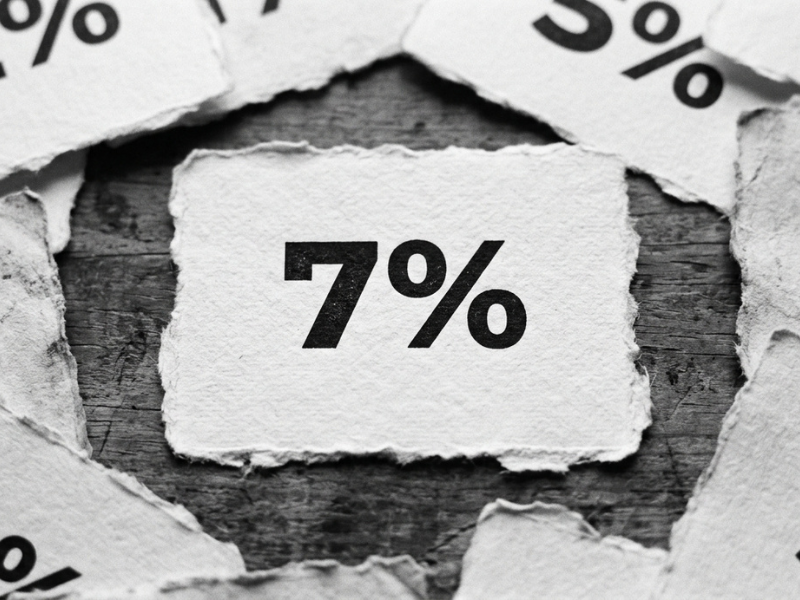
On paper, 7% is barely different from 6.9%. The monthly payment moves by a few dollars. But if you’ve bought, sold, or even thought about moving in the past few years, you know 7% has never felt like just a number. It feels like a line.
As of October 15, the average 30-year fixed rate is 7.40%, according to Freddie Mac. That’s the highest since November 2023, and more than a full point above where it was this time last year. So it’s worth asking two questions: why does this number carry so much weight, and what can you actually do about it?
The mental math: why 7% feels like a wall
Part of it is memory. In October 2022, mortgage rates crossed 7% for the first time since 2002. Just a year earlier they had been close to 3%. Rates more than doubled in twelve months, and buyers stepped back to recalculate what they could afford. A year after that, in October 2023, rates peaked at 7.79%, the highest since 2000, and buyer activity slowed dramatically.
After that peak, rates eased and spent most of the next two years in the 6s, touching 7% only briefly. On September 24, they crossed back over for the first time since January 2025. Now we’re sitting comfortably above it.
So 7% is more than just a rate; it’s attached to the moments the market slowed. And people tend to measure today’s rate against the one they remember, not against what’s typical over the long run. DMAR’s September Market Trends Report pointed to a recent Cotality survey that put the “magic” rate that would bring most buyers back into the market at 4.6%. That gap between what people hope for and what’s available is a big part of the hesitation.
Homeowners feel it too. Roughly four out of five outstanding mortgages carry a rate below 6%, and about half are at 4% or less. Trading a 3.5% loan for one above 7% is a big step, so many owners stay put. FHFA economists estimated this “lock-in” effect has cost the country about 1.3 million home sales.
What it’s doing to the Denver market
DMAR’s September numbers show the early effects. Pending sales, our best read on where buyer demand is heading, fell 13.4% from a year ago. Closed sales came in at 2,849, the fewest for any September in nearly two decades. Active listings reached 13,567, up 3.8% from last year and the highest at the end of a September since 2011.
Nationally, the pattern looks similar. HousingWire data shows inventory has grown by roughly 25,000 homes this year as rates climbed, after shrinking by about 9,000 during the same stretch last year when rates eased.
Denver homes aren’t sitting longer than a year ago, at least not yet. The median time on market was 32 days in September, compared with 35 last September. It did jump from 27 days in August, though, and most September closings went under contract in August, when rates were still near 6.7%. The full effect of 7%+ rates will show up in October and November. (We covered September’s numbers in more detail in our September Market Insights.)
The short version: demand is cooling, buyers have more choices, and both sides have more room to talk.
The real math: what a rate buydown is
A rate buydown is money paid upfront to lower your interest rate. It comes in two main forms.
A temporary buydown, such as a 2-1, lowers your rate by two points in the first year and one point in the second, then returns to the full rate from year three on. The cost is roughly the total of those monthly savings, set aside at closing.
A permanent buydown uses discount points. One point costs 1% of the loan amount and lowers your rate for the life of the loan. How much each point lowers the rate varies by lender and can change daily.
Either can be paid by the buyer, or by the seller as part of a negotiated credit.
For buyers: it’s okay to ask
What we’re seeing locally is more negotiating around seller concessions and less around price alone. A home that has been on the market for a few weeks is often the best place to start that conversation.
Before you write an offer, get a quote from your lender showing what a 2-1 buydown and a permanent buydown would cost on the loan you’re considering. Then you can ask for a specific dollar amount with a clear purpose. One thing to know: most lenders still qualify you at the full rate, not the reduced first-year rate, so a temporary buydown makes the early years easier but doesn’t stretch your budget.
For sellers: a price cut versus a buydown
Here’s how the same $15,000 plays out on a home at Denver’s September median price of $575,000. The buyer puts 20% down and finances $460,000 at 7.40%.
- No changes: monthly principal and interest is about $3,185.
- Option A, a $15,000 price cut: the price drops to $560,000 and the loan to $448,000. The payment falls to about $3,102, roughly $83 less per month.
- Option B, a $15,000 credit toward a 2-1 buydown: in year one the rate is 5.40% and the payment is about $2,583, roughly $602 less per month. In year two it’s 6.40% and about $2,877, roughly $308 less. From year three on it’s the full $3,185. The buydown costs about $10,900, leaving around $4,100 of the credit for the buyer’s closing costs.
- Option C, a $15,000 credit toward a permanent buydown: that’s about 3.3 points on a $460,000 loan. Depending on the lender’s pricing, it could bring the rate below 7% for the life of the loan.
For the seller, each option costs about the same $15,000. For the buyer, a price cut saves $83 a month. A buydown saves several hundred a month when it helps most, in the first years of owning a home. That makes the listing more attractive to buyers who are on the fence about rates.
A few guardrails
Seller contributions have limits that depend on the loan type. Conventional loans generally allow 3% of the price with less than 10% down, 6% with 10% to 25% down, and 9% with more than 25% down. FHA loans allow up to 6%. VA loans allow up to 4% in concessions, with normal closing costs treated separately. In the example above, $15,000 is about 2.6% of the price, well within the conventional limit at 20% down. The home still needs to appraise at the contract price. Your lender should confirm the exact numbers for your loan, including what happens to any unused buydown funds if you later refinance.
So, what’s in a number?
The 7% mark has come and gone before, in 2002, 2022, and 2023, and each time buyers and sellers adjusted. The number carries memory and a lot of emotion. The real math is about options, and right now there are more of them than the headline rate suggests. If you’d like to run these numbers for your own situation, we’re always glad to sit down with you and a trusted lender and work through them.
Inspired by writing in Keeping Current Matters. All writing is original, re-voiced, and locally grounded for the Nookhaven community.
We love sharing thoughtful perspectives on home, place, and everyday living. If this sparks a question or curiosity, we’d always be glad to connect and continue the conversation here.