Earlier this spring, we talked about what Denver’s water restrictions actually mean for homeowners this season. The watering schedules, the drought pricing, the new normal that’s starting to take shape across the Front Range. A lot of you felt it. The question we kept hearing afterward was a natural one: okay, so what do I actually do about my yard?
This is that piece.
Xeriscaping, or as Denver Water has started calling it: Coloradoscaping, is the most direct answer to that question. And it’s more achievable, and more attractive, than most people assume.
First, Let’s Retire the Rock Pile Image
When people hear “xeriscape,” many picture a front yard stripped down to gravel, a yucca in the corner, and not much else. That mental image is one of the biggest barriers to getting started and it’s not what Coloradoscaping actually looks like.
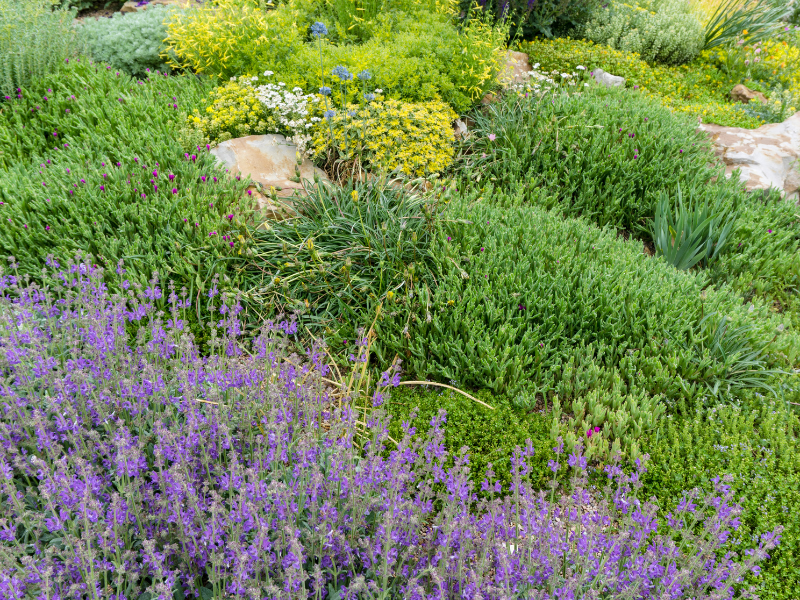
Denver Water has deliberately shifted to the term Coloradoscape to describe something different: a lively, layered outdoor space full of color, texture, and movement. Prairie grasses that catch the breeze. Flowering perennials that return every year without coaxing. Plants that have spent thousands of years figuring out exactly how to thrive in this climate. Done well, a water-wise yard doesn’t look sparse. It looks like it belongs here.
Start Where You Are
One of the most important things to understand about transitioning to a water-wise yard is that it doesn’t have to happen all at once. Most homeowners get there in stages, and that’s completely fine. Here’s a simple way to think about it.
If you want to start small: Pick one area, something like a side yard, a strip along the driveway, or a struggling patch of lawn that never quite recovers by August. Convert just that section by swapping in a few drought-tolerant perennials and some mulch, and let it settle for a season. You’ll spend almost no time maintaining it, and you’ll start to see what’s possible.
A great resource for this is Resource Central’s Garden In A Box program. Every June, they offer curated DIY kits starting around $132, designed specifically for Colorado yards. Complete with plant starts, a planting plan, and care instructions. It’s one of the lowest-friction ways to get something beautiful in the ground without guessing.
If you’re ready to go further: Consider removing a section of turf. Denver Water currently subsidizes lawn removal for customers in their service area through a partnership with Resource Central, bringing the cost down to $1 per square foot (versus the standard $2.75) up to a certain threshold. That’s a meaningful incentive, and it creates a clean slate for whatever you want to plant next.
Before you replant, it’s worth testing your soil. Colorado State University’s Soil, Water, and Plant Testing Laboratory analyzes samples from homeowners and provides a full report, including what amendments your specific yard might need. It takes the guesswork out of why things aren’t thriving.
If you’re ready to go all the way: A full Coloradoscape redesign is a bigger undertaking, but the payoff is significant. It will lower water bills, require far less maintenance, and give you a yard that looks genuinely alive year-round rather than just in the brief window when bluegrass is cooperating. For plant selection, Plant Select is the most reliable starting point: a vetted collection of grasses, shrubs, perennials, and trees proven to thrive in Rocky Mountain conditions, tested by horticulturists from CSU and Denver Botanic Gardens. If it carries the Plant Select seal, it’s built for here.
For a full redesign, bringing in a local landscape professional who specializes in water-wise design is worth the investment. They’ll account for drainage, sun exposure, soil type, and winter interest. These are all the things that determine whether a garden looks great year-round or just for a few weeks in June.
What to Expect Along the Way
New plantings, even if they are drought-tolerant, typically need regular watering during their first season while roots establish. That’s normal. The reward comes in year two and beyond, when most native and adapted plants can largely take care of themselves through a Colorado summer.
The maintenance calendar shrinks dramatically. The water bill follows. And the yard starts doing something a traditional lawn never quite manages: it looks interesting in every season, not just when it’s actively being kept alive.
A Good Time to Start
Denver Water is already in its strictest water restriction season since 2013. This summer will ask more of Front Range homeowners than recent seasons have. This also creates a genuine opening. The moment for changing your yard has never been clearer, the resources have never been more accessible, and the results, for the people who’ve already made the shift, speak for themselves.
You don’t have to redo everything. You just have to start somewhere.
Inspired by writing in 5280 Magazine. All writing is original, re-voiced, and locally grounded for the Nookhaven community.
We love sharing thoughtful perspectives on home, place, and everyday living. If this sparks a question or curiosity, we’d always be glad to connect and continue the conversation here.