Denver’s sprinklers are already off for the year. Here’s how to finish the season well anyway.
By Nookhaven Staff | October 17, 2026
Most years, the end of lawn season sneaks up on us. The grass slows down, the mower gets a little dusty, and one weekend we realize we’ve already made the last pass without knowing it.
This year, the end showed up on the calendar. After one of the hottest and driest years on record, Denver Water ended the lawn watering season on October 1. Sprinklers are off, and enforcement is real: fines can reach $2,000. That changes a few of the usual fall rules, but the final mow still matters. Here’s how to tell when you’ve reached it, and how to make it count.
The signs your grass is finishing up
It’s growing slowly and starting to brown. The clearest signal is a lawn that no longer needs you every weekend. Along the Front Range, that usually happens in late October or early November. This year, many lawns got there early. After a dry summer, some Kentucky bluegrass went dormant in August and never really came back. If yours is tan and hasn’t grown in weeks, it may already be done.
Daytime highs stay below 50 degrees. Cool-season grasses like bluegrass slow down sharply once days consistently stay in the 40s. One cold snap doesn’t count. Denver loves a 70-degree November afternoon, so watch for a pattern, not a single chilly week.
A full week passes without real growth. When you can skip a week and the lawn looks the same, you’re there.
The trees are mostly bare. This is the one people forget. Even after the grass stops growing, the mower’s job isn’t quite done, because leaves still need to come off the lawn.
How to make the last mow count
Leave it a little taller. Denver Water and CSU Extension recommend keeping Kentucky bluegrass at 2.5 to 3 inches, and higher during dry stretches. For the last few cuts, raise the deck another quarter to half inch, landing around 3 to 3.5 inches. A slightly taller canopy shades the soil and makes it harder for winter weeds to get started. It also helps a thirsty lawn hold onto what little moisture it has.
Don’t overcorrect. Too tall is a problem too. Long grass lies down under snow and mats, which invites snow mold in spring. Aim for upright and even, not shaggy.
Never take more than a third at once. If the lawn got ahead of you, bring it down over two passes a few days apart. Cutting too much in one go stresses the grass, and stressed grass going into a dry winter is the last thing you want.
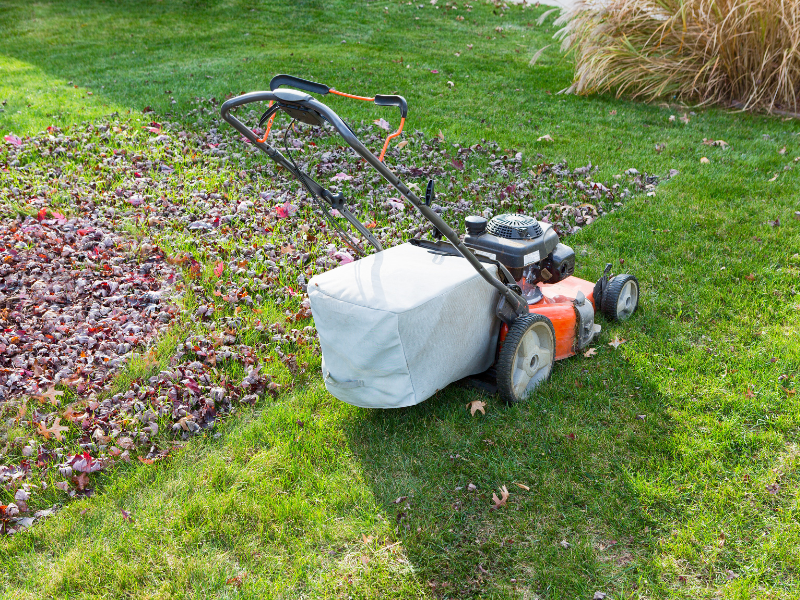
Mulch the leaves early, bag them late. In early and mid-fall, running the mower over leaves chops them into something the soil can use. By November, the soil is too cold to break them down, so switch to bagging for the final passes. A thick mat left on the lawn all winter smothers the grass underneath and leaves dead patches in spring. Denver residents can bring them to the city’s LeafDrop program. Weekday drop sites are open through November 25, and weekend sites open across the city on November 7 and 8, 14 and 15, and 21 and 22. Most sites take leaves in paper bags only, and the city offers a coupon for a free five-pack at participating Ace Hardware stores. If you have a green compost cart, leaves can go straight in.
What’s different in a dry year
Think twice about a winterizer. A late-fall feeding, usually around Thanksgiving, can help a lawn green up faster in spring. But CSU notes that fertilizer on dry turf does far less, because the grass needs moisture to take it up. With sprinklers off, the honest answer is that it may not be worth it this year. If you do apply one, time it just ahead of forecast snow so the moisture can carry it in.
Watch the south side. Winter mites love dry, south- and west-facing lawns, especially along driveways, sidewalks, and foundations, where reflected heat dries things out. You’d normally discourage them with a fall soak, but this year that’s not an option for most of us. If those strips look silvery or straw-colored in late winter, mites are a likely suspect, and the grass usually recovers once spring moisture returns.
Let it rest. A dormant lawn isn’t a dead one. Bluegrass is built to go brown and wait, and most lawns come back once spring brings moisture. If this summer has you rethinking how much lawn you actually want, our June piece on Coloradoscaping is a good place to start that conversation.
Worth knowing
The October 1 ban applies to Denver Water customers and prohibits sprinkler and spray irrigation of lawns. Hand watering of trees and plants is still allowed, but check Denver Water’s current rules before hand watering turf. Other providers set their own rules: Wheat Ridge, for example, also ended lawn watering after September 30. If you’re outside Denver Water’s service area, check with your water provider or HOA.
The last pass
There’s something satisfying about knowing it’s the last mow, even in a year when the calendar decided for us. Raise the deck, clear the leaves, and put the mower away clean. The grass will take it from here.
Inspired by writing in Real Simple. All writing is original, re-voiced, and locally grounded for the Nookhaven community.
We love sharing thoughtful perspectives on home, place, and everyday living. If this sparks a question or curiosity, we’d always be glad to connect and continue the conversation here.