Walk into many a garage in and around Denver and you’ll find the same thing, whether the house is a Highland bungalow or a new build out toward Green Valley Ranch: a workbench that’s seen some things, a pegboard of tools arranged with real intention, maybe a half-finished project sitting exactly where it was left last weekend. Nobody ever had to convince the person who built that space that it deserved to exist. It just does. The car needed somewhere to live, and so did the work of loving it.
It’s worth asking why that permission hasn’t always extended to the rest of the house.
The garage got there first
There’s something instructive in how naturally a garage becomes a hobby space. Nobody debates whether it’s frivolous to dedicate three hundred square feet to an engine that doesn’t need fixing yet, or a table saw that only comes out twice a season. It’s just accepted as part of owning the space. A place for hands-on work, tinkering, building, restoring. The garage has quietly been giving people permission to have a hobby all along. It just kept that permission to itself, tucked behind a door most guests never open.
Meanwhile, the reading chair, the paint set, the half-finished cross-stitch, the puzzle that’s been sitting on the di ning table for two weeks because nobody wanted to sweep it back into its box, those things have often had to apologize for the space they take up. As if enjoying something with your hands, purely because it’s enjoyable, needs a better excuse than a Saturday afternoon.
Why this is having a moment
Homes are shifting away from spaces designed purely to look finished, and toward spaces designed to actually be lived in. They are more layered, personal, a little imperfect, and built around what someone genuinely loves rather than what photographs well. A reading nook with a good lamp and an ugly, perfect chair. A corner of a spare room given over entirely to yarn and half-finished projects. A section of the basement that exists for nothing but records and a turntable.
None of it needs to be impressive. It needs to be used.
Kids get a playroom. Why don’t we?
Notice how easily a family will carve out a whole room for a kid’s toys, art supplies, and half-built Lego sets, no questions asked. It’s just understood that a child needs somewhere to play, to make a mess, to be fully absorbed in whatever they’re into that month. Nobody asks a seven-year-old to justify the square footage.
Somewhere along the way, we stopped extending that same understanding to ourselves. An adult who wants a corner for painting, or a shelf for a collection, or a table that stays set up for the puzzle in progress, often feels like they need a good excuse first. It’s as if j oy stops being a legitimate use of space once you’re paying the mortgage on it.
It doesn’t have to work that way. A home is a reflection of the people living in it, their personality, their pace, the things that make an ordinary Tuesday feel like theirs. That’s true whether you’re four years old with a box of crayons or forty-four with a sourdough starter you’ve named. The house doesn’t stop being allowed to reflect you just because you grew up.
What this looks like in a Denver home
This city already has the instinct for it, even outside the garage. Walk through RiNo on a First Friday and you’ll see it everywhere. There are studios, workbenches, and painting corners that started as a spare room before they became something someone built a life around. Denver’s older bungalows, with their awkward extra bedrooms and unfinished basements, are almost custom-built for this kind of repurposing. A closet with the door removed and some shelving becomes a proper craft nook. An underused dining room becomes a puzzle table that never has to be cleared. A corner of a basement, once just storage, becomes the one spot in the house that’s entirely, unapologetically someone’s.
It doesn’t take square footage. It takes a decision that the hobby is allowed to have a home, the same way the car always has.
A room for what you love
Not every hobby needs its own dedicated room, but almost every home already has a space quietly suited to one, if you look at it d ifferently:
The kitchen — for the person who bakes or cooks not out of necessity but because it’s genuinely where they feel most like themselves. A well-stocked spice drawer and counter space that’s actually cleared off is its own kind of hobby space, no separate room required.
The garage — already claimed by anyone who loves building, restoring, or fixing things with their hands.
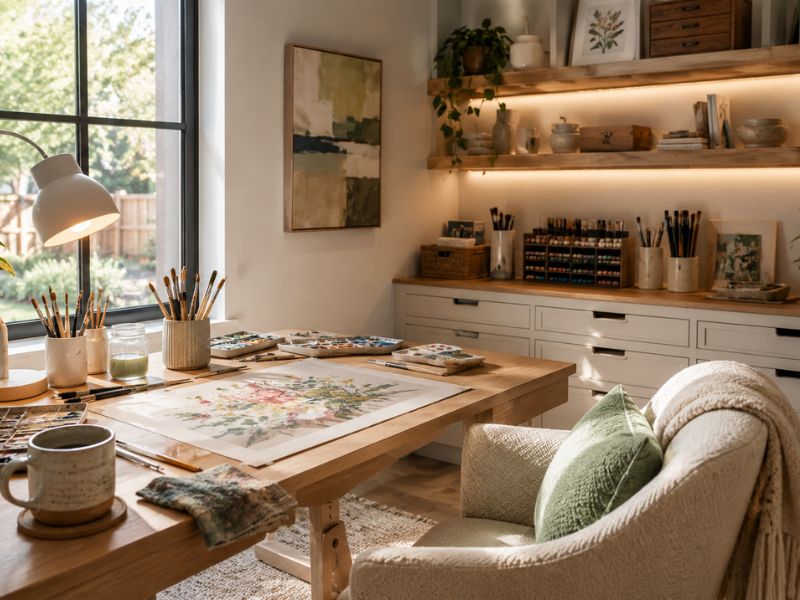
A spare room or closet — for painting, sewing, knitting, or anything that benefits from its supplies staying out and ready instead of packed away after every use.
A basement corner — for records, reading, model building, or anything that wants a quiet, slightly hidden-away feel.
A dining table or nook — for puzzles, journaling, or anything that likes staying half-finished in plain sight rather than living in a box.
The point isn’t finding the “correct” room for a hobby. It’s noticing that the room is probably already there, doing something less interesting than it could be.
Starting small
A dedicated hobby space doesn’t have to mean a renovation. It can be a single shelf that holds supplies instead of clutter, a chair moved to catch better light, a folding table that gets to stay set up instead of packed away after every use. The goal isn’t a showroom. It’s a spot that says, clearly, that whatever you love doing here is worth the room it takes.
Painting, knitting, reading, puzzles, baking, model building, woodworking that never quite made it out to the garage. None of it needs to earn its keep. It just needs somewhere to be. The garage figured that out a long time ago. The rest of the house is finally catching up.
We love sharing thoughtful perspectives on home, place, and everyday living. If this sparks a question or curiosity, we’d always be glad to connect and continue the conversation here.